
Spartanburg County Court Records After Arrest
The arrest-to-court path in Spartanburg County starts at the Spartanburg County Detention Center and then moves to magistrate, municipal, General Sessions, or Family Court records depending on the charge and warrant type. The sheriff's intake page says a new arrestee appears before a magistrate who explains the offense, rights, possible penalties, preliminary-hearing rights for eligible General Sessions charges, release conditions, and the court date. That first appearance is not the same thing as a conviction. It is the first court step after the jail arrest.
Jail booking records and court records after a jail arrest answer related but different questions. The jail record can identify custody, booking details, bail amount, and booking photo for current jail inmates. The court record tracks the filed case, court events, charge status, hearings, warrants, and disposition. For roster and custody facts, use the Spartanburg County jail inmate records page. For booking photos, use Spartanburg County jail mugshots.
Spartanburg Court Records Search
The official case-search route is the Spartanburg County Public Index from the South Carolina Judicial Branch. It is the key public route for court records after a jail arrest in Spartanburg County. A user can search by defendant name or case number once the case has been filed and indexed. The portal may not show a case at the exact moment a person is booked because jail intake, warrant service, bond processing, and formal court filing can occur on different timelines.
The official public index screenshot in the image manifest is subject-matched to court records after arrest.
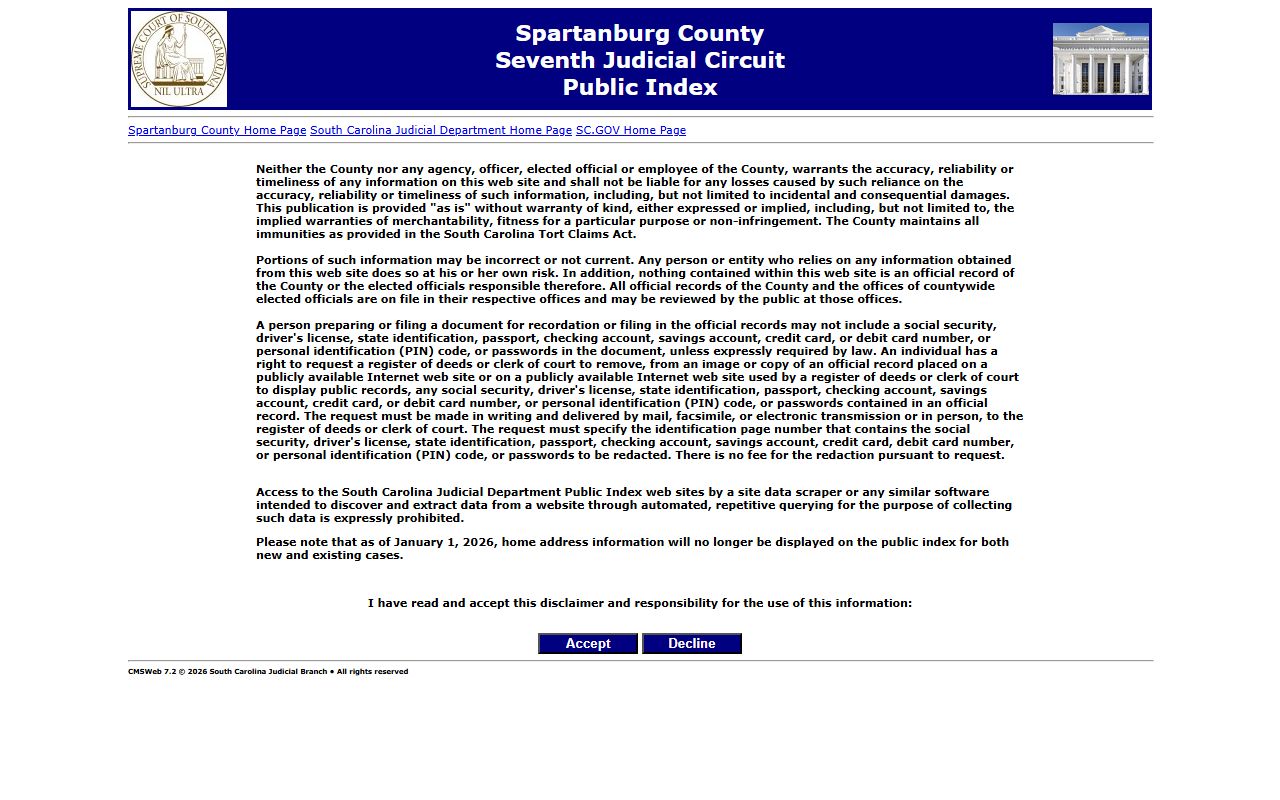
The public index should be read alongside jail records when a case is very new or the charge wording has changed since booking.
- Open the Spartanburg County Public Index and use the defendant name or case number if known.
- Look for Magistrate, Municipal, or General Sessions records tied to the arrest, citation, warrant, or court notice.
- Open the case and compare charge description, case type, court, filed date, events, hearings, status, and disposition.
- Check the jail roster separately for custody status, bail amount, and current booking information.
| Field Label | Type | Required | Options / Format Notes |
|---|---|---|---|
| County / court | Dropdown or route | Yes by route | Use the Spartanburg County public-index route. |
| Name search | Text | Conditional | Exact field labels were not captured; use defendant name when no case number is known. |
| Case number | Text | Conditional | Use when available from a citation, warrant, notice, or court paper. |
| Date range / case type | Filter | Optional | Exact filters were not confirmed in raw extraction. |
Charges After Spartanburg Arrest
Booking charges can be an early label for why the person entered jail. Court records after an arrest may use different language after law enforcement, the magistrate, and the 7th Circuit Solicitor review the facts. For more serious General Sessions matters, the solicitor prosecutes state criminal cases. For summary offenses, magistrate or municipal court may handle the case. A formal court charge may be amended, reduced, dismissed, indicted differently, or resolved through plea or trial.
| Document | Who Uses It | How It Fits After Arrest |
|---|---|---|
| Uniform traffic citation | Law enforcement officer | May start a summary criminal or traffic matter tied to the booking. |
| Arrest warrant | Magistrate or officer process | Can start custody after probable cause is presented or sworn facts are filed. |
| Preliminary hearing path | Magistrate Court | For eligible General Sessions charges with penalties over 30 days, rights are explained after arrest. |
| Indictment or solicitor prosecution | Grand jury and solicitor | Serious charges proceed through the solicitor and circuit criminal court. |
Spartanburg County Solicitor Records
South Carolina uses solicitors rather than district attorneys. Spartanburg County is in the 7th Judicial Circuit with Cherokee County. The 7th Circuit Solicitor's Office represents the State of South Carolina in criminal cases filed by law enforcement in Spartanburg and Cherokee counties. The county page names Barry Barnette as solicitor and says attorneys handle circuit court and family court hearings.
The solicitor's role matters because court records after a jail arrest may not match the jail roster word for word. The jail and bond record reflects arrest charges at intake. The solicitor's office handles state criminal prosecution in circuit-level matters after review. That review may lead to amendment, reduction, dismissal, indictment, plea, or trial. Court records are the place to check the filed status, not just the first booking label.
The county's solicitor page from the manifest provides the office source for Spartanburg County criminal prosecutions.
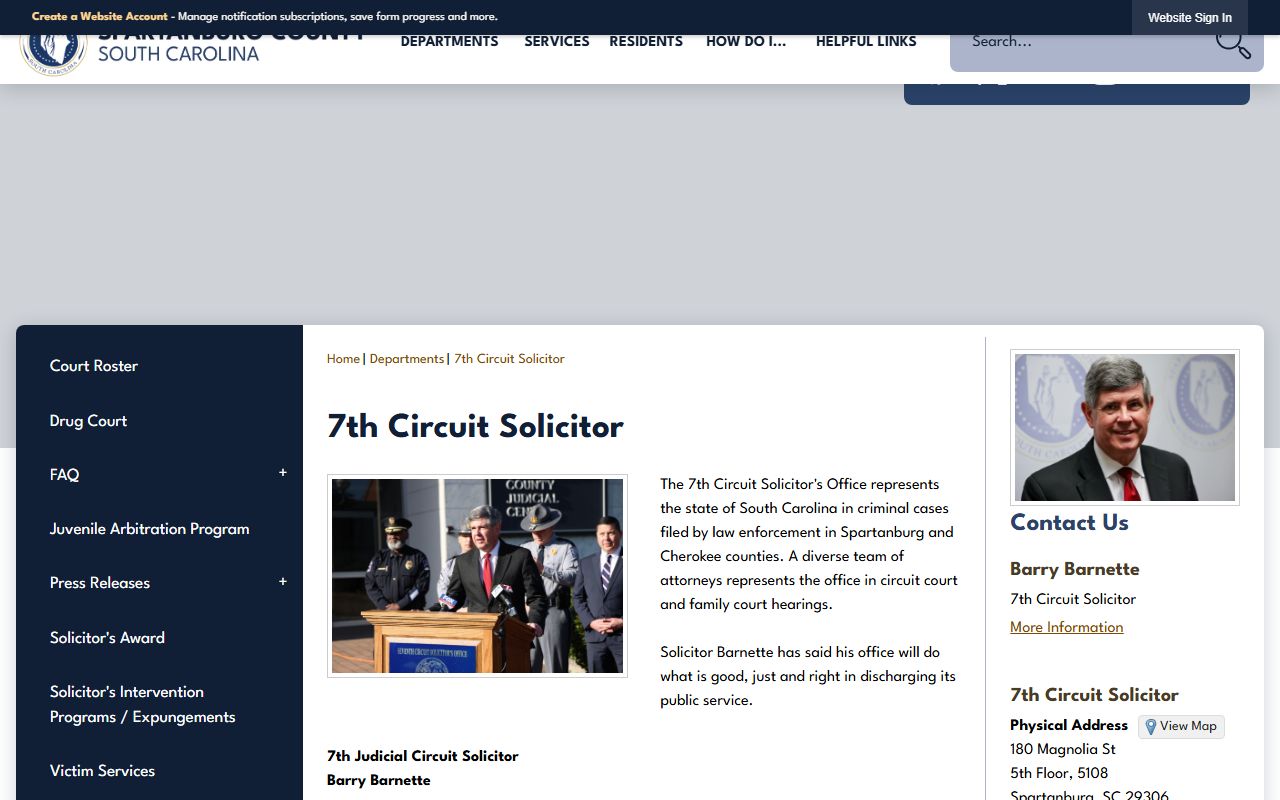
The office contact belongs to the prosecution path, while custody questions still belong to the jail or corrections agency holding the person.
Spartanburg Court Charge Status
Charge status changes are common in court records after a jail arrest. A charge may start as a booking allegation, then appear in the public index with a different code, level, or wording. Some charges move forward. Others are reduced, amended, dismissed, or not prosecuted. A disposition is the outcome of a specific charge or case, such as a guilty plea, conviction, dismissal, nolle prosequi, diversion, or acquittal.
| Status | What It Means |
|---|---|
| Pending | The charge remains open and has not reached final disposition. |
| Amended or reduced | The court record was changed from the original wording, level, or charge path. |
| Dismissed | The charge was ended by court action and did not result in conviction on that charge. |
| Nolle prosequi | The prosecutor chose not to proceed with the charge at that stage. |
| Convicted or guilty plea | The case ended with a finding or plea that creates a conviction record. |
Bond After Spartanburg Arrest
Bond is the release process before trial. The sheriff's Bail Proceedings page says Spartanburg County magistrates set most local bonds several times each day, every day of the year, including holidays. Most proceedings occur in the Magistrate Court offices at the Spartanburg County Detention Center. The page says a defendant usually does not enter a plea at the bond proceeding.
| Bond Type | How It Works |
|---|---|
| Personal recognizance | The accused signs a pledge to return to court and comply with conditions. |
| Surety bond | A person, property, cash, or bondsman backs the release if PR bond is not enough. |
| Cash deposit | Cash may be deposited with the court in the required amount or approved percentage. |
| No local magistrate release | Some General Sessions, Family Court, federal, parole, Governor's warrant, and other holds require another authority. |
Bond can affect custody status before the public index has every later case event. Victims may ask to attend or be heard at bond proceedings, and requested victim participation can affect timing.
Warrants and Court Records
No standalone official Spartanburg sheriff active-warrant search was confirmed in the research file. Court records after an arrest may still show warrant-related activity after a person is booked. The sheriff intake page lists arrest warrants, magistrate bench warrants, General Sessions bench warrants, Family Court bench warrants, municipal warrants, probation warrants, parole warrants, fugitive warrants, federal charges, and other court orders as intake authorities.
Release authority depends on warrant type. A magistrate bench warrant may require bench-warrant conditions to be met or a court order. A General Sessions bench warrant may require a Circuit Court judge. A Family Court bench warrant may require Family Court action. A federal offense is outside local magistrate release authority, and the person remains pending appearance before a federal judge. For warrant questions that are not answered by the public index, contact the issuing court or the Sheriff's Office routing number.
Charges and Convictions
An arrest charge is an accusation. A conviction is a court outcome. Spartanburg County court records after a jail arrest should be read with that gap in mind. The jail roster may show the intake reason or booking charge. The public index may later show a different formal charge, disposition, or status. A person remains presumed innocent unless and until a court record shows a conviction or guilty plea.
| Charge | Conviction | |
|---|---|---|
| Stage | Accusation after arrest or filing | Final finding, plea, or judgment |
| Proof level | Probable cause or charging decision | Beyond a reasonable doubt or valid plea |
| Record location | Jail roster, warrant, citation, or public index | Court disposition in the public index or court file |
| Can change? | Yes, charges can be amended or dismissed | Post-judgment relief or expungement rules may apply in limited cases |
Sealed and Expunged Records
South Carolina expungement law is in S.C. Code Title 17, Chapter 22. Expungement is the statutory route for clearing eligible arrest or court records. Eligibility depends on the charge, outcome, prior record, waiting period, and statutory category. A dismissal does not always mean every public trace disappears at once, and a booking photo or jail record may need a separate records-clearing or agency process depending on the record type.
| Sealed | Expunged | |
|---|---|---|
| Public view | Restricted from ordinary public access | Cleared under the eligible statutory process |
| Agency access | Some official access may remain | Access depends on the expungement order and law |
| Eligibility | Depends on record type and court order | Depends on South Carolina expungement statutes and disposition |
| Best source | Clerk or issuing court | Solicitor, clerk, court order, or qualified legal counsel |
Restricted Court Records After Arrest
Not every arrest-related record is public in the same way. South Carolina FOIA is at S.C. Code Title 30, Chapter 4, and Section 30-4-40 includes law-enforcement, privacy, safety, and other exemptions that may limit release. Juvenile matters, sealed cases, expunged records, active investigations, confidential informants, and some safety-sensitive details may be withheld or redacted. Public index results also may lag behind jail booking events.
Important: This site is not a consumer reporting agency and court or jail information may not be used for FCRA-covered decisions.
Public Record Search
Sponsored Results